Composition side by side
Limits in % by weight. Zinc is the remainder.
| Element | CW614N | CW617N |
|---|---|---|
| Copper (Cu) | 57.0–59.0 | 57.0–59.0 |
| Lead (Pb) | 2.5–3.5 | 1.6–2.5 |
| Aluminium (Al) | ≤ 0.05 | ≤ 0.05 |
| Iron (Fe) | ≤ 0.3 | ≤ 0.3 |
| Nickel (Ni) | ≤ 0.3 | ≤ 0.3 |
| Tin (Sn) | ≤ 0.3 | ≤ 0.3 |
| Zinc (Zn) | Remainder | Remainder |
Rod to EN 12164, forging stock to EN 12165. Check the edition your drawing calls up; the 3.1 certificate shows the actual heat analysis.
Machining
Lead does not dissolve in brass. It sits as fine particles that break the chip as it forms, so the chip comes off short. That is why CW614N, with the most lead, is the reference against which mills rate the machinability of other copper alloys.
CW617N machines well too, but with less lead the chips are a little longer. For high-volume parts turned complete from bar on cam automats or CNC lathes (pins, bushes, terminals, inserts, gland bodies) CW614N usually gives the shortest cycle and the best finish.
Forging
Both grades contain the β phase that makes brass easy to hot-work, and both can be hot-forged. CW617N is the grade most often used for hot forging and is supplied as forging stock to EN 12165. Mill datasheets give hot-working ranges of roughly 650–750 °C; follow the supplier's figure for the bar you buy.
Neither grade is meant for cold forming. Parts that are crimped, bent, cold-headed or deep-drawn need a lead-free α brass such as CW508L (CuZn37).
Which grade for which part
| Part | Usual grade | Why |
|---|---|---|
| Turned from bar: pins, bushes, spacers, terminals, inserts, gland bodies | CW614N | Shortest chips, fastest cycle |
| Hot-forged: fitting and valve bodies, tees, manifolds | CW617N | Forging stock grade; machined after forging |
| Crimped, bent or cold-headed | CW508L | Ductile α brass for cold forming |
| In contact with drinking water | DZR or lead-free grade | Lead-free and DZR brass |
Strength depends on the material condition as well as on the grade. Rod conditions are written as R360, R430 and so on, where the number is the minimum tensile strength in MPa (EN 1173). If strength matters, put the condition on the drawing next to the grade.
Equivalents
Nearest equivalents, not exact matches.
| EN number | EN designation | BS | UNS | IS | JIS |
|---|---|---|---|---|---|
| CW614N | CuZn39Pb3 | CZ121Pb3 | C38500 | IS 319 Type I | C3604 |
| CW617N | CuZn40Pb2 | CZ122 | C37700 | — | C3771 |
Compositions overlap but are not identical; always check the specification your drawing calls up. More grades: brass grade equivalents.
Lead, RoHS and REACH
RoHS. Both grades exceed the 0.1 % lead limit and rely on exemption 6(c), which allows up to 4 % lead in copper alloys. The exemption is currently valid until 30 June 2027 (Delegated Directive (EU) 2025/2364). If your product must not depend on it, use a lead-free grade such as CW724R.
REACH. Lead is a substance of very high concern. Above 0.1 % by weight in an article, the supplier must pass on Article 33 information. We provide that statement on request.
Writing it on the drawing
A clear material callout saves a round of questions at quotation:
Material: CW614N (CuZn39Pb3) to EN 12164, R430
Certificate: EN 10204 3.1
We run CW614N and CW617N as standard, and low-lead DZR CW511L, lead-free CW724R and DZR CW602N on request. An EN 10204 3.1 certificate comes with every batch.
Questions
Is CW614N the same as CZ121?
Can CW614N be forged?
Which is stronger, CW614N or CW617N?
Is CW617N suitable for drinking water?
What is the JIS equivalent of CW614N?
Related
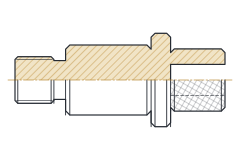
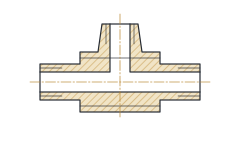
Have a drawing?
Send it with the grade you need; we confirm the grade and certificate with the quote.