
BSP vs NPT threads
Both are inch-sized pipe threads with nearly the same outside diameters, which is why they get mixed up. They differ in flank angle, in pitch for most sizes and in how they seal, so a BSP part and an NPT part should not be joined directly.
The two profiles
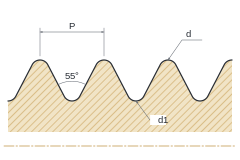
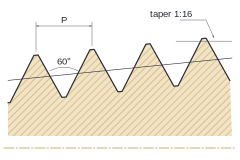
| BSP | NPT | |
|---|---|---|
| Flank angle | 55° | 60° |
| Crests and roots | Rounded | Flat |
| Standards | ISO 228-1 (G, parallel) · ISO 7-1 (R, Rc, Rp) | ASME B1.20.1 |
| Taper | G parallel; R and Rc taper 1:16 | Always 1:16 on diameter |
| Where it seals | G: on a washer, O-ring or face. R: on the thread, with sealant | On the thread, with sealant or tape |
| Written as | G 1/2 · R 1/2 · Rc 1/2 · Rp 1/2 | 1/2-14 NPT |
| Mainly used in | Europe, UK, India, Asia, Australia | USA and Canada |
Size by size
Threads per inch and outside diameters in mm.
| Size | BSP TPI | NPT TPI | BSP major Ø | NPT pipe OD | Same pitch? |
|---|---|---|---|---|---|
| 1/8 | 28 | 27 | 9.728 | 10.29 | No |
| 1/4 | 19 | 18 | 13.157 | 13.72 | No |
| 3/8 | 19 | 18 | 16.662 | 17.15 | No |
| 1/2 | 14 | 14 | 20.955 | 21.34 | Yes, angle differs |
| 3/4 | 14 | 14 | 26.441 | 26.67 | Yes, angle differs |
| 1 | 11 | 11.5 | 33.249 | 33.40 | No |
| 1 1/4 | 11 | 11.5 | 41.910 | 42.16 | No |
| 1 1/2 | 11 | 11.5 | 47.803 | 48.26 | No |
| 2 | 11 | 11.5 | 59.614 | 60.33 | No |
BSP major Ø to ISO 228-1; NPT pipe OD to ASME B1.20.1 (converted from inch). Full data: BSP thread chart · NPT thread chart.
Why they don't mix
- Different pitch in most sizes: the threads drift out of step after one or two turns and bind or cross-thread.
- Different angle at 1/2 and 3/4 inch: the parts screw together, but the 55° and 60° flanks touch only along a line and leave a spiral gap. Sealant may hold for a while; the joint is not reliable under pressure.
- Parallel against taper: a tapered male in a parallel G female seals, if at all, on the first threads only. BSP sealing joints pair R (taper male) with Rc or Rp.
How to tell which one you have
- Count the threads per inch with a thread gauge. Try a 55° Whitworth gauge and a 60° gauge: the one that sits without light showing gives the angle.
- Measure the outside diameter of a male thread with calipers and compare it with the table above.
- Check for taper: measure the diameter at the first and the fourth full thread. If it grows, the thread is tapered (NPT, or BSP R).
- Look at the seat: a flat face or a groove for a washer or O-ring suggests BSP parallel (G).
Connecting BSP and NPT
Use an adapter with the right thread at each end, or make one of the parts in the other thread. For cable entries we make lock nuts, stop plugs and reducers in BSP and NPT, 3/8 to 1 1/2 inch, and thread adapters from NPT to metric. Brass fittings are made to your drawing in BSP or NPT.
Questions
Will a 1/2 inch BSP thread fit a 1/2 inch NPT thread?
What do G, R, Rc and Rp mean?
Is BSPT the same as NPT?
Do NPT threads need sealant?
What is the thread angle of BSP?
Related


Need BSP or NPT parts?
Fittings to drawing and gland accessories in BSP and NPT. Send a drawing or part codes.